



Innovative and connected technology
The ACQUAPROCESS® anti-limescale process uses a low-frequency induction system that modifies the limescale properties of water.
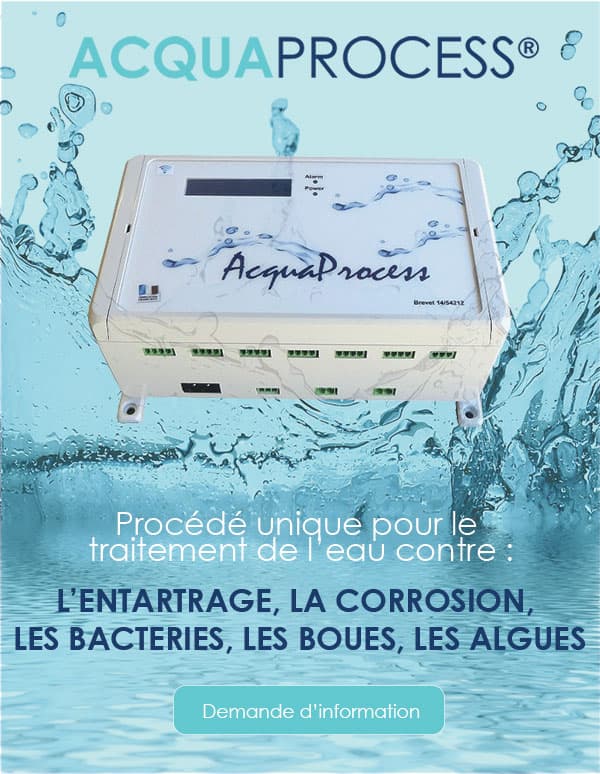
The ACQUAPROCESS® system consists of a generator that sends signals of varying frequency and power directly to the pipe to be treated via two wound inductors, thereby creating a low-frequency electric field.
The spectrum generated by these indicators acts on the physical and chemical properties of the water molecule, which is thus modified without interfering with its initial characteristics. Solubility is increased. Incrusting calcite is suspended in the water in the form of powdery, non-incrusting aragonite, which no longer sticks to the internal walls of the hydraulic circuit but remains in suspension. Pipes and heating elements are protected!
An innovation in water treatment
The innovation lies in this process which, unlike its competitors, adapts to all hydraulic network configurations and water quality conditions, making ACQUAPROCESS® a highly reliable solution.
In fact, water treatment is very complex, as it is necessary to take into account its TH, pH, flow rate, network configuration and temperature, which varies from one site to another. This is why most devices on the market are criticised for not being completely reliable.
Gentle physical treatment for healthy, high-performance water
The performance of the ACQUAPROCESS® system goes far beyond limescale treatment, a specific adaptation of this system enables it to act on bacterial proliferationlegionella and microalgae treatment , anti-limescale for swimming pools)), without the use of chemicals..
L’Limescale build-up in pipes, heating elements or taps creates a biofilm in which 99% of the bacteria present in the water system reside.
The ACQUAPROCESS® system modifies the molecule responsible for limescale formation, eliminating biofilm (via the Van Der Waals forces) and thereby reducing bacterial proliferation. Electromagnetic induction triggers a chemical reaction during which electrons are transferred, known as the REDOX (REDuction OXydation) process.
This process is triggered by a current source, producing oxidising agents that act on the environment by removing rust and biofilm, thereby limiting conditions conducive to bacterial growth.
All the advantages of ACQUAPROCESS®
WITHOUT ANY CHEMICALS
PREVENTS THE FORMATION OF LIME SCALE DEPOSITS
REMOVES LIME SCALE BUILD-UP
PREVENTS THE PROLIFERATION OF MICROALGAE
REDUCES MICROBIAL & BACTERIAL PRESENCE
NO MAINTENANCE COSTS
Only ACQUAPROCESS® addresses the issues
of bacteria and certain viruses.
LEGIONELLA AND PRION, FOR EXAMPLE
ACQUAPROCESS® remote management
Our connected application will enable you to monitor all indicators and stay informed in real time.
ACQUAPROCESS® is also an interactive system that collects all the information from the hydraulic circuit via sensors and transmits it to the server via GSM, Wi-Fi or intranet.
It allows you to easily monitor its operation from a mobile phone, computer, or tablet.
The water treatment is very complex, as it is necessary to take into account its TH, PH, flow rate, network configuration and temperature, which varies from one site to another. This is why most devices on the market are criticised for their lack of reliability.
The purpose of chemical treatment is to act on the elements present in the water and modify the properties of the components present.
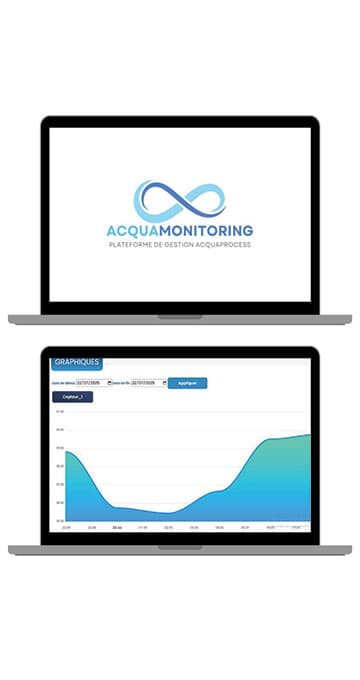
We know that limescale is more active as temperatures rise. By setting a lower temperature limit and an upper temperature limit, as soon as the system detects that the lower or upper limit has been exceeded, it will take action by modifying the settings on the wave generators.
Users will be able to remotely consult all archived and current information from the ACQUAPROCESS® system in real time, namely:
- The actions and results of the connected sensors.
- The correct functioning of the ACQUAPROCESS® system
- The actions of the RS485 LAN connection.
- The alarm connection, the reason for the alert, and the frequency of downtime.
- The actions of the GSM connection.