


Limescale control systems and ecology: what is the best alternative?
Limescale is a universal problem. Whether in a residential building, a hotel, a hospital or an industrial site,scaling in water networks is both a technical, economic… and environmental issue.
Faced with this reality, many limescale control systems are available on the market. But are they all compatible with an environmentally responsible approach? And above all, which alternative makes it possible to treat limescale without creating new ecological impacts?
Limescale: a discreet but costly enemy
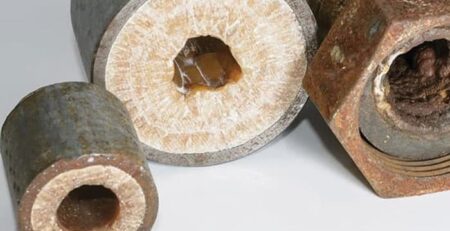
Le limescale naturally present in water (mainly in the form of calcium carbonate) leads, over time, to:
- deposits in pipework,
- fouling of heat exchangers,
- increased energy consumption,
- premature equipment failure,
- higher corrective maintenance costs.
From an ecological perspective, a scaled network also means:
- more energy required to heat water,
- more frequent equipment replacement,
- increased use of chemicals to counteract the effects.
Limescale is therefore not merely a comfort issue, but a genuine environmental concern.
Conventional Anti-Scale Solutions: Effective… But at What Cost?
Salt-Based Water Softeners
This is the most widely known solution. It relies on ion exchange: calcium is replaced with sodium.
Advantages:
- effective limescale reduction,
- rapid protection of installations.
Environmental limitations:
- high salt consumption,
- discharge of brine into wastewater systems,
- negative impact on wastewater treatment plants,
- chemically modified water,
- heavy and regular maintenance requirements.
From an environmental standpoint,salt-based softeners remain a highly debatable solution.
Chemical Anti-Scale Treatments
These systems inject products designed to prevent limescale crystallization.
Advantages:
- targeted action,
- relatively simple implementation.
Environmental limitations:
- addition of chemical substances to water,
- efficiency dependent on precise dosing,
- potential corrosion risks,
- product storage and handling constraints,
- non-negligible environmental impact.
So-Called “Magnetic” or Passive Solutions
Widely present on the market, these systems promise action without energy consumption or maintenance.
Advantages:
- no chemicals,
- simple installation.
Limitations:
- variable efficiency that may decrease over time,
- lack of genuine continuous action,
- results difficult to measure in complex networks,
- poorly suited to professional buildings.
Ecology Applied to Water Treatment: A Shift in Approach
When discussing ecology, it is not only about eliminating chemicals.
It also involves:
- reducing energy consumption,
- extending the lifespan of installations,
- limiting corrective maintenance,
- acting sustainably rather than temporarily.
The real question is not “which system removes limescale the fastest,” but “which system limits its effects over time without creating new environmental constraints?”.
An Ecological Alternative: Physical Limescale Treatment
The Principle of Physical Treatment
Unlike water softening, physical treatment:
- does not remove calcium,
- does not alter the chemical composition of water,
- acts on the crystalline structure of limescale.
Le carbonate de calcium shifts from an encrusting form (calcite) to a non-adherent form (aragonite), significantly reducing deposits within the network.
ACQUAPROCESS®: A Long-Term Anti-Scale Solution Designed for Sustainability
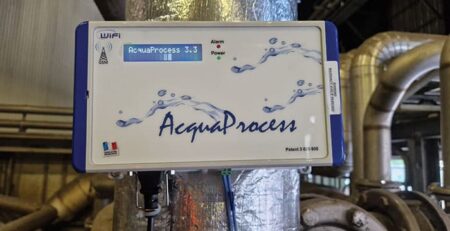
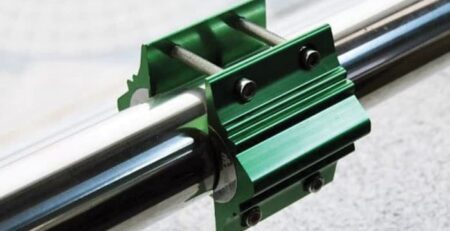
Le ACQUAPROCESS® limescale prevention system ACQUAPROCESS® anti-scale system fully aligns with this ecological and sustainable approach.
How Does ACQUAPROCESS® Work?
- Patented Ultra-Low Frequency (ULF) technology
- Continuous physical action on water, with no impact on the user
- Transformation of encrusting limescale
- Progressive reduction of existing deposits
- Indirect action on biofilm
All without salt, chemicals, or polluting discharge.
Concrete Environmental Benefits
- No salt consumption
- No brine discharge
- No product storage or handling
- Reduced need for chemical descaling
- Improved energy performance
- Extended equipment lifespan
The environmental impact is minimized from installation and continues to decrease over time.
A Solution Adapted to Professional Buildings
ACQUAPROCESS® is particularly relevant for:
- hotels and residential facilities,,
- hospitals and healthcare establishments,,
- commercial buildings,,
- industrial sites,,
- complex water networks..
Its action is continuous, independent of usage patterns, and does not rely on daily human intervention.
What Is the Best Ecological Anti-Scale Alternative?
From a long-term perspective, the most environmentally coherent solution is the one that:
- adds nothing to the water,
- discharges nothing into the environment,
- reduces overall energy consumption,
- limits corrective maintenance,
- acts sustainably on the root causes.
Within this framework, anti-scale treatment through ACQUAPROCESS® appears today as one of the most responsible alternatives available.