

Why Is Limescale So Costly for Collective Buildings?
In a multi-unit building — whether a hotel, residential complex, hospital, office building, or industrial facility — water circulates continuously. It supplies showers, kitchens, heating systems, hot water tanks, and heat exchangers. Although invisible in daily operations, a silent enemy gradually builds up inside the pipework: limescale.
It is often seen as nothing more than an aesthetic inconvenience. White marks on taps, scaled heating elements, clogged showerheads… Nothing alarming at first glance. Yet in multi-unit buildings, limescale represents a considerable cost — from energy consumption to sanitation issues and financial losses.
So why does limescale weigh so heavily on a building’s operating budget? And how can an anti-limescale system such as ACQUAPROCESS® sustainably reduce its impact?
Limescale: A Natural Phenomenon with Major Technical Consequences
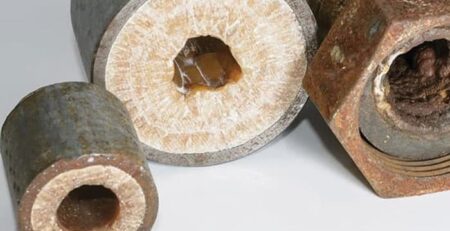
The limescale mainly comes from calcium and magnesium naturally present in water. When water is heated — especially within domestic hot water systems — these minerals precipitate and form scale deposits that accumulate on pipe walls and equipment surfaces.
In a single-family home, the impact often remains limited. In a multi-unit building, the situation is very different. The larger the network, the higher the temperature, and the more constant the circulation, the faster scaling develops. Scale accumulates in:
- hot water tanks;
- heat exchangers;
- boilers;
- pipework;
- taps and mixing valves.
And every millimeter of scale has a direct impact on performance.
Rising Energy Costs
This is often the largest hidden expense. Scale acts as thermal insulation. When it builds up on a heating element or heat exchanger, it prevents heat from being transferred efficiently to the water.
As a result :
the system must consume more energy to reach the same temperature. It is estimated that just one millimeter of limescale can reduce thermal efficiency by up to 10%.
In facilities such as hotels or hospitals, where hot water is produced 24/7, the impact becomes substantial.
The concrete effects include:
- higher energy bills;
- overheating heating elements;
- longer heating cycles;
- overall lower energy efficiency.
At the scale of a multi-unit building, this can represent several thousand euros per year. In that context, an effective anti-limescale system becomes not a cost, but an energy optimization tool.
Increased Maintenance and Premature Equipment Wear
The limescale ne se contente pas de faire grimper les factures. Il accélère aussi la dégradation des équipements.
In a scaled network:
- valves become blocked;
- pumps work harder;
- seals wear out faster;
- boilers become clogged;
- heat exchangers lose efficiency.
The result : more technical interventions, more descaling operations, and more frequent replacement of parts. In multi-unit buildings, every intervention represents:
- equipment costs;
- labor costs;
- and sometimes service interruptions.
In a hotel, a hot water failure directly affects the guest experience. In a hospital, it can disrupt care delivery.
The limescale therefore becomes a genuine operational risk.
The Link Between Limescale, Biofilm, and Legionella
Scale is often considered a purely technical problem. In reality, it also has major sanitary implications. Limescale deposits create rough surfaces inside pipework. These irregularities promote microorganism adhesion and biofilm formation — the slimy matrix where bacteria can grow protected from disinfectants.
This is precisely where Legionella pneumophilathe bacterium responsible for Legionnaires’ disease.
The mechanism is simple:
- Limescale creates a rough surface.
- Biofilm adheres to it.
- Bacteria multiply inside it.
- The water network becomes more vulnerable to contamination.
In public-access facilities, the sanitary risk is significant.
Regulatory monitoring is strict, and the consequences of contamination can be severe — both in human and legal terms.
Limescale therefore costs more than energy: it indirectly increases the risk of legionella contamination.
Often Underestimated Indirect Costs
Beyond energy and maintenance, additional hidden costs accumulate:
- excess water consumption due to flushing;
- increased use of chemical treatments;
- administrative time spent managing incidents;
- reputational damage in case of sanitary issues;
- premature depreciation of real estate assets.
In residential or commercial buildings, these costs are distributed across occupants. For facility managers, however, they represent a significant budget burden. limescale acts as an invisible tax on building performance.
Why Traditional Solutions Are Not Always Enough
To address the issue, many facilities rely on salt-based water softeners. While these systems reduce water hardness, they also come with several limitations:
- regular salt consumption;
- discharge of polluting brine;
- demanding maintenance;
- alteration of water composition;
- ongoing operating costs.
Other solutions, such as magnetic devices, may lack consistent performance.
In In multi-unit buildings, where water volumes are high and hydraulic systems complex — choosing a reliable, measurable, and long-lasting solution is essential.
ACQUAPROCESS®: A Comprehensive Anti-Limescale Approach
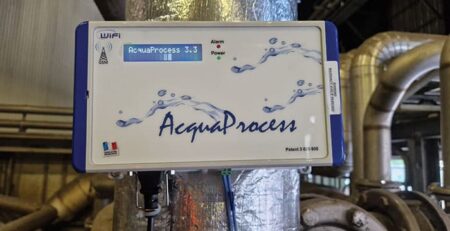
This is precisely the objective of the anti-limescale system ACQUAPROCESS®.
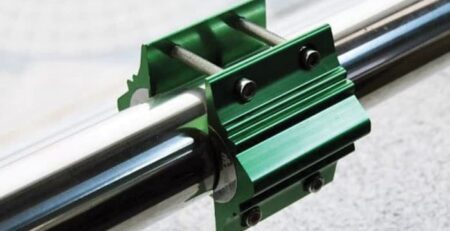
Unlike conventional water softeners, ACQUAPROCESS® does not remove minerals from the water. Instead, it acts on their crystalline structure to prevent them from adhering to surfaces.
Minerals remain suspended and are naturally flushed away without forming hard deposits. This approach offers several advantages:
- no salt;
- no polluting discharge;
- preserved drinking water quality;
- continuous operation;
- simplified maintenance.
But the benefits go even further.
Positive Impact on Biofilm and Microbiological Quality
By limiting mineral deposits, ACQUAPROCESS® reduces the surfaces on which biofilm can develop. Less scale means:
- fewer stagnation zones;
- fewer bacterial niches;
- fewer favorable conditions for microbial growth.
The system therefore contributes to overall water treatmentby addressing both mineral scaling and microbiological risks.
For sensitive facilities such as hospitals, nursing homes, and hotels, this becomes a strategic advantage.
Measurable Savings in the Short and Long Term
Field feedback shows that installing an efficient anti-limescale system can provide:
- significant energy savings;
- reduced descaling operations;
- fewer scale-related breakdowns;
- longer equipment lifespan;
- improved sanitary stability.
Return on investment is often measured within only a few years — sometimes even faster in facilities with heavy hot water usage.
At a time when energy costs continue to rise, limescale control has become a strategic priority.
Limescale as an Environmental Challenge
Fighting scale is not just about reducing operating costs.
It also helps to:
- reduce energy consumption;
- limit chemical usage;
- decrease pollutant discharge;
- preserve water resources.
An anti-limescale system as ACQUAPROCESS® supports a sustainable development strategy aligned with modern CSR policies for building managers.