

How to remove biofilm from pipes: understanding, prevention and long-term action
If you manage a water network — whether in a hotel, hospital, residential building, or industrial facility — you have probably already heard about biofilmThis invisible yet persistent phenomenon is particularly concerning. biofilm, is the thin bacterial layer that gradually forms inside pipework and quickly becomes an ideal environment for bacteria such as Legionella pneumophilathe bacterium responsible for Legionnaires’ disease.
But how does it form? Why is it so resistant to conventional treatments? And most importantly, how can it be eliminated sustainably without damaging installations or harming the environment?
This is where ACQUAPROCESS® comes in: an innovative technology that continuously acts on biofilm, while preserving both water quality and equipment.
What is biofilm?
The biofilmis a community of microorganisms (bacteria, fungi, and algae) that attach themselves to the inner surfaces of water pipes. In just a few days, these microorganisms produce a slimy substance — a kind of “biological glue” — that allows them to firmly adhere to warm, humid areas within the network.
At first glance, this deposit may seem harmless. In reality, it acts as a protective shield for pathogenic bacteria. Inside this matrix, they multiply while remaining protected from disinfectants and can quickly colonize an entire network.
Biofilm therefore acts as:
- a bacterial reservoir, including Legionella;
- a thermal insulator that promotes stagnation and corrosion;
- an obstacle to water treatment, by limiting the effectiveness of disinfectants.
Why biofilm is a major problem in water networks
The biofilm does not only affect the microbiological quality of water. It also impacts energy efficiency and the durability of installations.
Some direct consequences include:
- Increased sanitary risk : biofilm is the main carrier of Legionella, responsible for severe respiratory infections that can lead to serious complications.
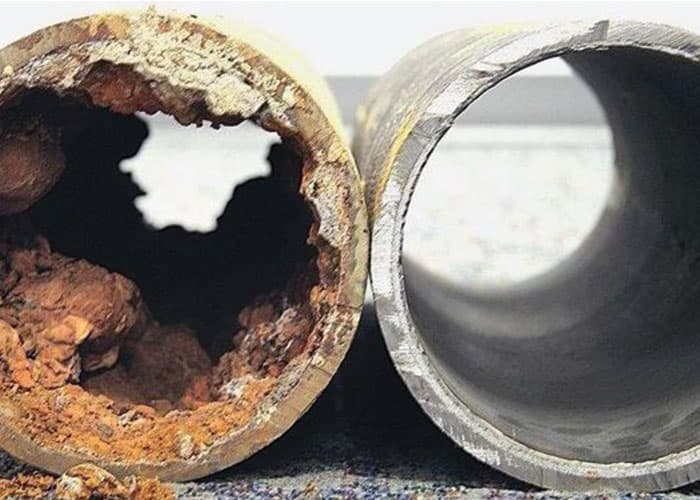
- Network deterioration : biofilm promotes corrosion, scale deposits, and pipe blockages.
- Higher energy consumption : internal deposits reduce heat transfer efficiency, forcing boilers and water heaters to work harder.
- Reduced flow and unstable pressure : biofilm resistance interferes with normal water circulation.
In short, ignoring biofilmmeans allowing an invisible, costly, and potentially dangerous problem to develop.
The main causes of biofilm formation
The biofilm does not appear randomly. Several factors encourage its development:
- Favorable temperatures (25–45°C)
Ideal conditions for bacterial growth, especially Legionella. - Stagnant water, secondary loops or dead legs become ideal refuges for biofilm.
- Scale deposits and corrosion
Surface roughness caused by limescale or corrosion creates niches where microorganisms can attach. - Irregular maintenance
A poorly monitored, insufficiently flushed, or badly designed network quickly becomes vulnerable to microbial colonization. - Ineffective or poorly dosed disinfectants
Occasional treatments such as chlorine, hyperchlorination, or peroxide may kill free-floating bacteria, but most remain protected inside the biofilm.
Why conventional treatments fail against biofilm
The main issue with biofilmis its resistance. The bacteria it contains are not directly exposed to disinfectants because they remain hidden behind a thick polysaccharide barrier.
As a result:
- occasional chlorination eliminates free-floating bacteria but not attached colonies;
- thermal treatments (raising water temperature to 70°C) partially destroy biofilm, but it often reforms within days;
- mechanical cleaning is almost impossible in complex water systems.
The result is always the same: despite expensive interventions, biofilm keeps coming back. This is why a curative and temporary approach must be replaced by a preventive and continuous solution.
ACQUAPROCESS®: a sustainable solution against biofilm
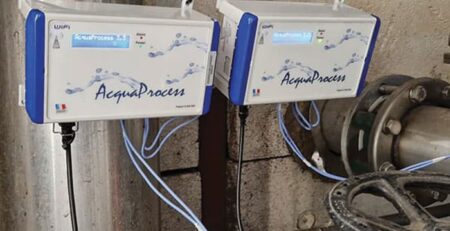
This is precisely what the ACQUAPROCESS® process offers: patented water treatment technology water treatment capable of continuously acting within pipe networks.
A simple yet revolutionary principle
The ACQUAPROCESS® system combines several actions:
- breakdown of existing biofilm;
- prevention of biofilm reformation through gentle continuous treatment;
- optimization of water microbiological quality without altering physicochemical properties.
Unlike conventional chemical treatments, ACQUAPROCESS® does not rely on aggressive overdosing. It acts directly on the structure of biofilm, modifying the environment in which bacteria develop.
A dual action: preventive and curative
ACQUAPROCESS® progressively removes existing biofilm , while preventing its return. This continuous action ensures a clean and healthy water network, even in complex environments such as hospitals, hotels, residential facilities, and industrial sites.
An environmentally friendly process that protects installations
One of ACQUAPROCESS®’s major strengths is its eco-friendly and non-aggressive approach:
- no chlorine-based products harmful to pipes or users;
- no toxic discharge into the environment;
- full compliance with REACH regulations.
This gentle approach extends equipment lifespan, reduces corrosion, and preserves the energy efficiency of the network.
Even better, ACQUAPROCESS® also acts as a natural anti-limescale system. By stabilizing water and reducing deposit formation, it limits mineral buildup often associated with biofilm.
How ACQUAPROCESS® installation works
Installation is designed to be simple, with minimal disruption to operations:
- Existing network audit ACQUAPROCESS technicians analyze sensitive points such as temperature, stagnation zones, corrosion, and existing biofilm.
- Module integration The devices are installed directly on the network without heavy dismantling.
- Commissioning and monitoring Additional sensors can be installed to monitor water temperature and performance in real time.
This turnkey service allows operators to delegate Legionella and biofilm risk management with peace of mind.
The concrete benefits of a biofilm-free network
Les retours d’expérience des établissements équipés sont éloquents :
- Réduction de plus de 90 % de la charge bactérienne en quelques mois ;
- Stabilisation durable de la qualité de l’eau sans choc chimique ;
- Baisse des coûts d’entretien et d’énergie grâce à un réseau propre ;
- Conformité sanitaire garantie, sans fermetures ni interventions d’urgence ;
- Prolongation de la durée de vie des installations hydrauliques.
En somme, éliminer le biofilm, c’est investir dans la santé du réseau, la sécurité des usagers et la performance énergétique.
Biofilm, légionellose et calcaire : un trio indissociable
Il est important de comprendre que le biofilm, le limescale et la légionelle sont intimement liés.
Le calcaire crée des aspérités où le biofilm s’accroche. Ce biofilm, à son tour, devient l’abri parfait pour Legionella.
Résultat : même un ACQUAPROCESS® anti-limescale system incomplet ne suffit pas à prévenir la legionella contamination, s’il ne traite pas le biofilm à la source.
ACQUAPROCESS® agit donc sur ces trois fronts simultanément :
- il empêche le tartre de se déposer,
- il désagrège le biofilm existant,
- il empêche la prolifération bactérienne, dont Legionella.
C’est une solution globale, continue et intelligente.
La technologie au service de la prévention : monitoring et suivi en temps réel
Les installations modernes d’ACQUAPROCESS® s’inscrivent dans une approche de gestion intelligente de l’eau.
Grâce à un système de capteurs connectés (IoT), les responsables techniques peuvent :
- suivre la qualité microbiologique du réseau en temps réel ;
- recevoir des alertes automatiques en cas de dérive (température, débit, contamination) ;
La prévention : un investissement rentable et durable
Éliminer le biofilm, ce n’est pas seulement une question de propreté. C’est un enjeu sanitaire, économique et écologique.
Un réseau sans biofilm, c’est :
- moins de risques pour la santé publique (légionellose, contamination bactérienne) ;
- moins de gaspillage énergétique (meilleurs échanges thermiques) ;
- moins de maintenance corrective ;
- une durabilité accrue des équipements.
Les établissements qui adoptent une stratégie préventive avec ACQUAPROCESS® constatent souvent un retour sur investissement rapide : en quelques mois, la baisse des interventions d’urgence et des coûts énergétiques compense largement le coût du système.
Vers une nouvelle vision du traitement de l’eau
The biofilm a longtemps été considéré comme une fatalité dans les réseaux hydrauliques. Mais grâce à des solutions comme ACQUAPROCESS®, on entre dans une nouvelle ère : celle de la prévention continue, mesurable et respectueuse de l’environnement.
Plutôt que de “désinfecter à la crise”, il est désormais possible de maintenir la qualité de l’eau en permanence, tout en respectant les normes sanitaires et environnementales.