

Filtration and Limescale: Why Is Your Swimming Pool Losing Efficiency?
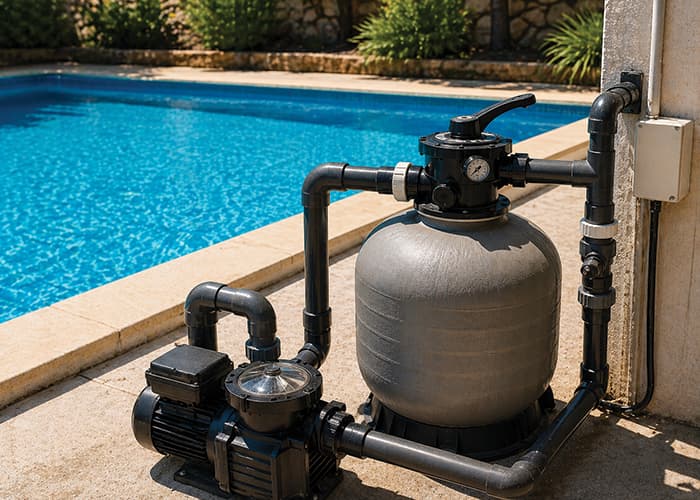
Clear, clean, and well-balanced pool water depends on one essential component: the filtration system. It plays a central role in removing impurities, circulating water, and maintaining a healthy environment for swimmers.
However, many pool owners — both private individuals and managers of public or commercial pools — notice a gradual decline in the efficiency of their filtration system. The water becomes cloudier, chemical treatments seem less effective, and maintenance interventions become more frequent.
In most cases, one hidden culprit is responsible for these issues: limescale. Often underestimated, limescale affects the entire hydraulic system at a deeper level. It clogs equipment, promotes biofilm formation, disrupts water circulation, and can even contribute to sanitary imbalances.
So why does limescale have such a major impact on swimming pool filtration ? More importantly, how can you solve the problem sustainably with a solution such as ACQUAPROCESS®?
The Essential Role of Filtration in a Swimming Pool
Before understanding the impact of limescale, it is important to recall the purpose of pool filtration.
mming pool operates as a closed-loop system. Water is drawn from the pool, filtered, and then returned to the basin. This cycle makes it possible to:
- remove suspended particles;
- distribute treatment chemicals evenly;
- prevent stagnant water;
- maintain clear and healthy water.
An efficient filtration system relies on several key components:
- the pump;
- the filter (sand, cartridge, or diatomaceous earth);
- the pipework;
- the return jets.
When everything operates properly, water is continuously filtered and remains balanced. But as soon as one component deteriorates, overall water quality begins to suffer.
Limescale: An Invisible Enemy for Your Pool
Limescale is naturally present in water, especially in regions with hard water. In a swimming pool, several factors accelerate scale formation:
- water temperature;
- evaporation;
- pH fluctuations;
- fresh water refills.
Over time, calcium precipitates and forms scale deposits on surfaces and inside equipment. Contrary to what many people think, the issue is not limited to visible deposits on pool walls. The real danger lies inside the circulation system.
How Limescale Damages Filtration
Filter Clogging
The filter is often the first component affected. Scale accumulates in the filtration media (sand or cartridge), reducing its ability to capture impurities.
The result:
- filtration becomes less efficient;
- cloudy water persists;
- cleaning frequency increases.
Reduced Water Flow
Limescale also builds up inside pipes, creating resistance to water flow.
This leads to:
- reduced flow rate;
- poor water circulation;
- stagnant zones in the pool.
Water that circulates poorly deteriorates much faster.
Limescale and Biofilm: A Problematic Combination
Beyond the technical issues, limescale also promotes biofilm.
Biofilm is a layer of microorganisms that develops on wet surfaces.
In swimming pools, it commonly forms on:
- pipe walls;
- filters;
- skimmers;
- hydraulic equipment.
Limescale creates surface roughness that makes it easier for biofilm to adhere.
To better understand this phenomenon, you can read our article: ➡️ How to Remove Biofilm from Pipes
Once established, biofilm acts as a protective barrier for bacteria. It reduces the effectiveness of chemical treatments and makes disinfection more difficult.
A Direct Impact on Water Quality
When pool filtration and treatment are disrupted, water quality declines rapidly.
The most common warning signs include:
- cloudy water;
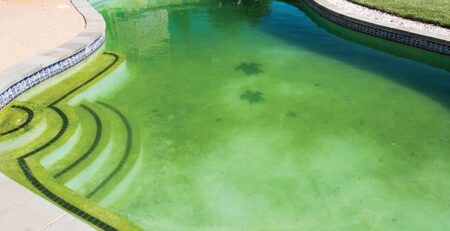
- algae growth;
- pH imbalance;
- excessive chlorine consumption;
- white deposits on pool walls.
In collective pools such as hotels, residential complexes, and aquatic centers, these problems can quickly become critical.
The Hidden Costs of Limescale in Swimming Pools
Just as in collective buildings, limescale generates costs that are often underestimated:
- increased consumption of treatment chemicals;
- more frequent maintenance;
- premature filter replacement;
- accelerated pump wear;
- higher energy consumption.
Moreover, this phenomenon is similar to what is observed in conventional water distribution systems:
➡️ Why Does Limescale Cost Collective Buildings So Much
In a swimming pool, these costs can quickly add up over the course of a full season.
The Limitations of Traditional Solutions
Several solutions are commonly used to fight limescale:
- anti-scale chemicals;
- pH adjustment;
- partial draining;
- water softeners.
However, these approaches often have significant limitations:
- temporary effectiveness;
- regular intervention required;
- dependence on chemicals;
- environmental impact.
In a continuously operating system such as a swimming pool, these solutions rarely provide long-term results.
ACQUAPROCESS®: A Sustainable Solution for Swimming Pools
The ACQUAPROCESS® anti-limescale system provides a comprehensive answer to limescale problems.
Unlike temporary treatments, it works continuously within the water circuit.
How It Works
ACQUAPROCESS® modifies the structure of limescale, preventing it from adhering to surfaces. Mineral particles remain suspended in the water and are naturally flushed away.
Benefits for Filtration
- cleaner filters;
- improved water flow;
- reduced scale deposits inside pipework;
- more stable water quality.
The result is a filtration system that regains its original performance.
Positive Impact on Biofilm and Bacteria
By limiting mineral deposits, ACQUAPROCESS® also reduces the conditions that encourage biofilm development.
Less biofilm means:
- more effective chemical treatments;
- reduced bacterial presence;
- improved overall sanitary quality.
This is especially important in sensitive environments where water hygiene is critical.
➡️ Water Treatment in Hospital Environments: What Are the Challenges?
Even though a swimming pool is not a hospital, the principle remains the same: better water control leads to safer water.
An Eco-Friendly and Cost-Effective Solution
One of the major advantages of ACQUAPROCESS® is its environmentally responsible approach:
- no salt;
- no aggressive chemicals;
- no polluting discharge;
- low maintenance.
At the same time, the financial benefits are substantial:
- reduced treatment product consumption;
- lower maintenance costs;
- fewer equipment replacements;
- optimized energy consumption.
How to Integrate ACQUAPROCESS® into a Swimming Pool
Installation is straight forward:
- Hydraulic system audit
- Module installation on the water network
- Commissioning with minimal downtime
- Performance monitoring and follow-up
The system then operates autonomously, with periodic monitoring if required.
Toward Smarter Pool Water Management
Today, water management is evolving toward smarter and more sustainable solutions. The goal is no longer simply to correct problems after they occur, but to prevent them before they arise.
With systems such as ACQUAPROCESS®, it becomes possible to:
- maintain consistent water quality;
- reduce emergency interventions;
- optimize operating costs;
- improve the user experience.